


Removing a herniated disc from the neck does not always mean fusing the bones around it. In a cervical discectomy without fusion, the surgeon takes out the disc material pressing on a nerve and leaves no hardware behind. There are two ways to do it. At ESINY, it is done from the back of the neck with endoscopic spine surgery, so the disc stays in place and the neck keeps moving.
If you have been told you need a fusion, this guide explains how the two routes differ, what the research shows, who is a good fit, and what surgery and recovery involve.
Key Takeaways
- The back-of-neck route is the established way to skip fusion. It removes only the fragment or bone spur on the nerve through an incision under 1 cm, and the disc stays in place.
- Success rates run above 90% for both fusion and back-of-neck decompression without fusion. Symptoms return in about 3% of patients after the back-of-neck approach.
- More than 85% of acute pinched nerves in the neck settle within 8 to 12 weeks without surgery. Surgery becomes an option when 4 to 8 weeks of real non-surgical care haven't helped.
- Fusion is still the right call for a spine that is unstable, collapsing, or out of alignment. For a single pinched nerve, removing the pressure can be enough.
- With the endoscopic back-of-neck approach, 95% of patients go home the same day, and most are fully cleared within 8 to 12 weeks. Full recovery after a standard neck fusion usually takes 3 to 4 months.
What Cervical Discectomy Without Fusion Actually Does
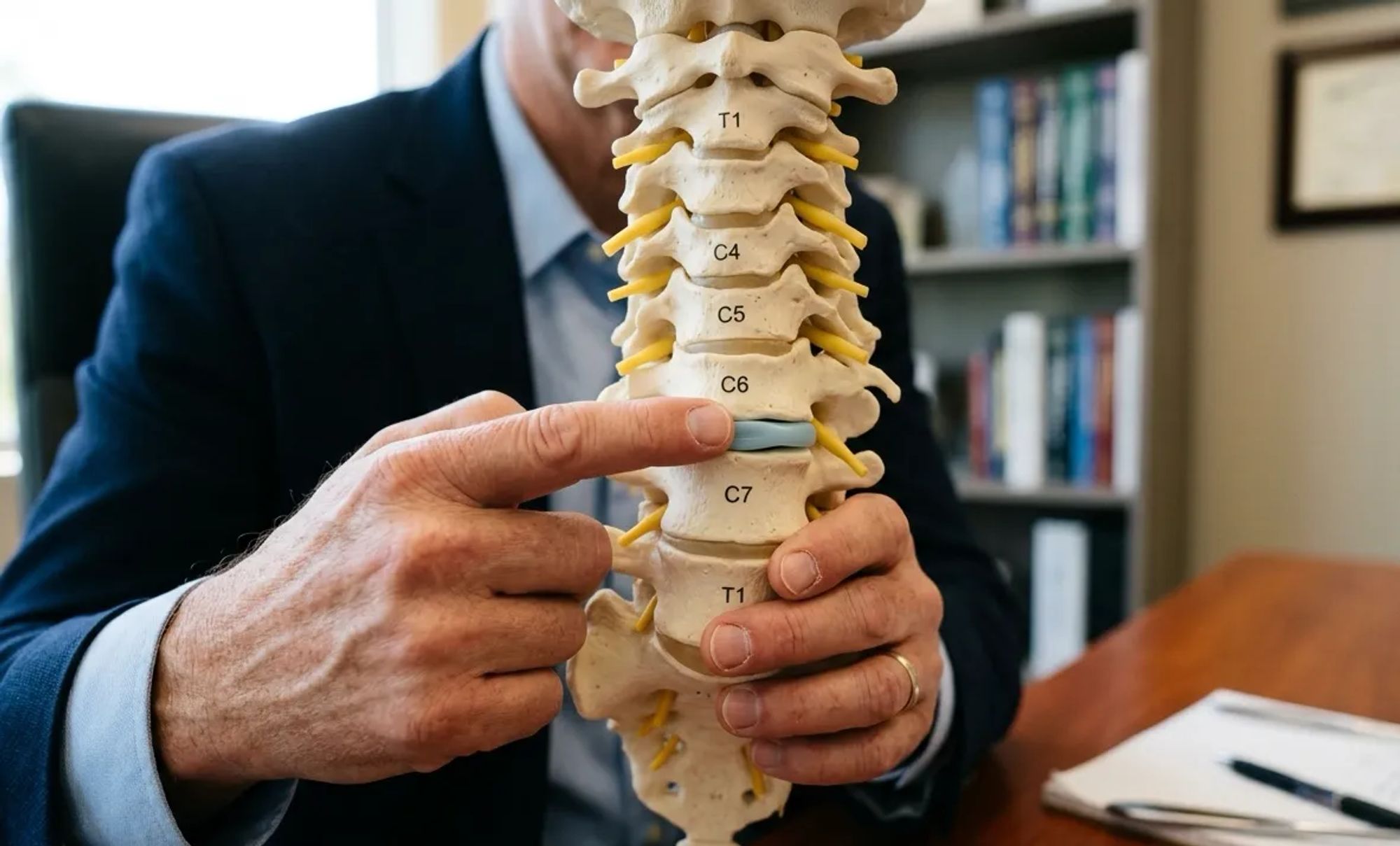
This surgery treats a herniated disc that presses on a nerve in the neck and causes arm pain, numbness, or weakness from cervical radiculopathy. The surgeon removes the disc material causing that pressure and adds nothing in its place. With no cage, plate, or bone graft, nothing has to heal into bone afterward.
It works best when the problem is one point of pressure on a nerve, such as a disc fragment or a bone spur, and the spine itself is stable. Taking that pressure off is what relieves the arm symptoms.
Front of the Neck or Back of the Neck
The surgery can be done through the front or the back of the neck. From the front, the surgeon removes the entire disc.
From the back, the surgeon works through the opening where the nerve leaves the spine and removes only the fragment or bone spur pressing on it. This back-of-neck version is often called a cervical foraminotomy.
Clinical reviews describe front-of-neck discectomy without fusion as outside mainstream surgical practice. The back-of-neck approach, with or without disc removal, is an established option that works as well as front-of-neck surgery in well-selected patients.
Feature | Front of the neck | Back of the neck |
|---|---|---|
What is removed | The entire disc | Only the fragment or bone spur on the nerve |
Hardware | None | None |
Incision | About 1 to 4 inches across the front of the neck | Under 1 cm with the endoscopic technique |
Motion at that level | Kept at first, though the empty space can narrow | Kept |
Do Results Without Fusion Hold Up Against ACDF?
For a pinched nerve in the neck, the surgery most often recommended is ACDF, short for anterior cervical discectomy and fusion. The surgeon removes the whole disc, fills the space with a bone graft or cage, and usually adds a small metal plate to hold it. Over the next 6 to 12 months, the two vertebrae grow into one solid bone.
That fusion locks the level so it can no longer move. For a pinched nerve, though, relief comes from freeing the nerve, so results without fusion hold up. A paper in the Journal of Spine Surgery reports success rates above 90% for both ACDF and posterior decompression without fusion, and ESINY's own Dr. Albert E. Telfeian is one of its co-authors.
Leaving fusion out also changes what your body has to recover from. There is no implant, the operation is shorter, and there are no months of waiting for bone to heal. The same paper notes that fusion from the front adds stress to the levels above and below it. It can also affect swallowing or the voice, two problems the back-of-neck route avoids.
The surgery does have limits. After posterior decompression, symptoms return in about 3% of patients, and some of them later have a fusion.
Who Is a Good Fit for Surgery Without Fusion

The best fit is one pinched nerve, imaging that matches your symptoms, and a stable spine. For ESINY's surgeons, nerve compression that shows on a scan and matches what you actually feel is the clearest reason to operate.
Even then, surgery is rarely the first step. According to StatPearls from the National Library of Medicine, more than 85% of acute cases of cervical radiculopathy settle within 8 to 12 weeks without specific treatment. Physical therapy, anti-inflammatory medication, activity changes, and sometimes a steroid injection come first, and that applies to a C5-C6 disc bulge too. If you haven't tried them yet, our surgeons will tell you that plainly.
Weakness that keeps getting worse, a failing grip, or numbness spreading into both hands calls for prompt evaluation. Trouble with balance, clumsy hands, or any change in bladder or bowel control points to pressure on the spinal cord and needs urgent care. Without those signs, surgery becomes a fair conversation when 4 to 8 weeks of real non-surgical care haven't helped.
Often a good fit for surgery without fusion | Often better served by fusion |
|---|---|
Arm pain, numbness, or weakness from a pinched nerve | True spinal instability |
A disc herniation or bone spur pressing on one spot | Significant deformity of the neck |
Imaging that matches your symptoms | Collapse across several levels |
A stable spine on X-ray | Advanced spinal cord damage, called myelopathy |
A new disc problem next to an old fusion | Some cases where an earlier decompression failed |
That last row on the left matters if you already had a fusion. A new disc problem at the level above or below an old fusion does not always mean extending it. An endoscopic decompression can relieve the pressure without adding more hardware.
What Happens During the Procedure
For the front-of-neck approach, you are asleep under general anesthesia and lying on your back. The surgeon makes a small horizontal cut in a skin crease, gently moves the windpipe and food pipe aside, and reaches the disc.
Using a microscope, the surgeon removes the disc and any bone spurs pressing on the nerve. Nothing is placed in the empty space before the incision is closed.
For the back-of-neck approach, ESINY performs the procedure endoscopically. A small high-definition camera passes through an incision under 1 cm, moving between muscle fibers instead of cutting through them.
The surgeon widens the nerve's exit opening and removes only what is pressing on the nerve, while the disc stays in place. Some of these procedures use local anesthesia with light sedation, and most patients go home the same day.
Risks of Surgery, and When Waiting Stops Helping

Every spine operation carries some risk, and a few of them depend on the route. The possible complications include:
- Trouble swallowing: A front-of-neck risk that is common in the first days after surgery.
- Hoarse voice: A front-of-neck risk caused by irritation of the nerve that controls the vocal cords.
- Dural tear: A small tear in the sac around the nerves that can leak spinal fluid, possible with either route.
- C5 palsy: Rare shoulder weakness after neck surgery, possible with either route.
Most of these improve with time. The back-of-neck route also carries a risk of nerve irritation or incomplete relief, and infection and bleeding are uncommon with either route.
Waiting has a cost of its own when compression is serious, because a nerve that stays squeezed for a long time may not fully recover. That makes an evaluation worth scheduling, even if surgery turns out not to be the next step.
How Long Recovery Takes Without Fusion
Recovery without fusion is shorter because there is no bone graft that has to heal first. With ESINY's endoscopic back-of-neck approach, 95% of patients walk out the same day and start light activity right away. By comparison, full recovery after ACDF usually takes 3 to 4 months, and a front-of-neck discectomy typically means one night in the hospital.
Stage | What most ESINY patients can expect |
|---|---|
Day of surgery | Walking out the same day with a small bandage |
First week | Light walking and normal household activities |
2 to 4 weeks | Many patients return to office work and daily routines, and driving resumes once neck motion feels comfortable |
8 to 12 weeks | Full clearance after an endoscopic foraminotomy |
As with any herniated disc surgery recovery, your timeline depends on your imaging, your symptoms, and the work you do.
What to Ask Your Surgeon Before You Decide
Discectomy without fusion is one of several alternatives to cervical fusion. Another option you may hear about is cervical disc replacement, which keeps motion with an artificial disc. Like fusion, though, it removes the whole disc even when the problem is one small point of pressure.
Whatever you are offered, three questions help you compare. Ask what exactly is pressing on the nerve, whether your spine is stable on X-ray, and whether a smaller procedure could solve the same problem.
Your Next Step Before Neck Surgery
When one disc fragment or bone spur is pressing on a nerve, removing that pressure can bring relief without fusing the neck. Your imaging shows whether that describes you or whether fusion is the better answer, and our surgeons will tell you which one fits.
The Endoscopic Spine Institute of New York is the only dedicated endoscopic spine institute in America. Patients come from across the United States and overseas for endoscopic spine surgery in New York, and more than 40 spine surgeons have chosen ESINY for their own care.
New patients get a full hour with their surgeon, and after surgery, your ESINY doctor personally calls to check on you. If fusion has been recommended to you and you want a second opinion, contact us and tell us your story.
FAQs About Discectomy Without Fusion
How big is the scar after a discectomy without fusion?
Very small with the endoscopic back-of-neck approach. The incision is under 1 cm, about the size of a pencil eraser, and most patients go home with a simple bandage. Front-of-neck surgery needs a longer cut, usually placed in a skin crease.
Will I be awake during endoscopic neck surgery?
Sometimes. Some endoscopic procedures through the back of the neck use local anesthesia with light sedation, which keeps you comfortable and responsive. Front-of-neck surgery is done under general anesthesia, and your surgeon decides which fits your case.
What happens to the disc space when no fusion is done?
After a front-of-neck discectomy, it narrows. The empty space settles over time, and in some patients the two vertebrae slowly grow together on their own. With the back-of-neck approach, the disc stays in place, so there is no empty space.
This post was written and reviewed by Sanjay Konakondla, MD. Sanjay Konakondla is a leading endoscopic spine surgeon and a founding partner of the Endoscopic Spine Institute of New York.
ESINY is the nation’s first and only endoscopic spine institute and is solely focused on the smallest spine surgery possible. With the world-renowned neurosurgeons at ESINY and the specialized surgery they have perfected, you can feel confident that you will have the best chance at getting back to the life you deserve with the least amount of surgery.
Call us now at 518 708 6300 or email us directly at contact@esiny.com to schedule a consultation.