


Endoscopic vs arthroscopic surgery comes down to location: endoscopy is the broad category of camera-guided procedures, and arthroscopy is the version performed inside joints. If you've been searching this question and walking away more confused than when you started, you're not alone.
At the Endoscopic Spine Institute of New York, it is one of the most common questions new patients arrive with, and an important one. The two terms sound similar and get used interchangeably online, yet they describe fundamentally different tools for different parts of the body. This article breaks down both procedures, compares them directly on the criteria that matter most, and explains which approach applies to your situation.
Why These Two Terms Are So Often Confused
Your surgeon said "scope surgery." Google gave you ten different answers. That's the real origin of this confusion: not a failure on your part, but a gap in how these terms get used in patient-facing materials. Both arthroscopy and endoscopy are minimally invasive, both involve a camera inserted through small incisions, and both get casually lumped together as "scope surgeries" in patient forums and online articles. In everyday conversation, "scope" can mean a colonoscopy, a knee procedure, or a spine operation, so the word alone tells you very little.
Here's the clearest way to think about it: endoscopy is the parent category, and arthroscopy is a specialized subset. All arthroscopes are endoscopes, but not all endoscopes are arthroscopes.
That distinction changes something concrete for you: it determines which specialist you should be seeing, what your recovery looks like, and whether a given technique is even appropriate for your anatomy. Understanding the difference between arthroscopy and endoscopy isn't a trivia exercise; it's a practical filter that points you toward the right care faster.
What Is Endoscopy and What Is Arthroscopy?
Endoscopy and arthroscopy share a family resemblance, but they differ in the body systems they access, the instruments they use, and the conditions they treat.
Endoscopic Surgery: A Versatile Tool for Internal Access
Endoscopy is a surgical and diagnostic technique that uses a slender tube, rigid or flexible, fitted with a camera and light source to access internal body cavities. It's used across multiple systems, including the GI tract, respiratory system, and musculoskeletal system. In orthopedic and spine surgery specifically, endoscopic techniques access the spine through portals as small as a few millimeters to treat conditions like herniated discs, spinal stenosis, and nerve compression.
What is endoscopic spine surgery in practice? It means a surgeon uses purpose-built instruments, designed for the spine's unique anatomy, to decompress nerves or remove disc material without disrupting the surrounding muscles and bone the way traditional open surgery would.
The Endoscopic Spine Institute of New York (ESINY) specializes in these techniques. ESINY is dedicated entirely to endoscopic spine surgery, with high surgical volume, a body of published research, and experience with advanced and complex cases.
Arthroscopic Surgery: Joint-Specific Precision
Arthroscopy is a surgical technique where a rigid arthroscope is inserted into a joint space: the knee, shoulder, hip, elbow, or wrist. Because joints have a natural internal cavity, the arthroscope can navigate that space with minimal tissue disruption. What is arthroscopic surgery used for? Primarily cartilage repair, ligament reconstruction, meniscus surgery, labral repair, and joint debridement. Recovery depends on the joint and the procedure, ranging from a few weeks after simple debridement to several months after ligament or labral reconstruction.
Both techniques require deep specialization and are not interchangeable skill sets, even when they look similar from the outside. Understanding what arthroscopy is, and what it isn't, is essential before assuming it applies to spine conditions. It generally doesn't, because the spinal canal and discs are not a joint cavity.
A Direct Comparison of Endoscopic and Arthroscopic Surgery

The differences between endoscopic and arthroscopic surgery go beyond terminology. The table below breaks down the key distinctions across the criteria that matter most to patients evaluating their options.
Criteria | Endoscopic Surgery | Arthroscopic Surgery |
|---|---|---|
Primary Use / Body Area | Spine, GI tract, respiratory, soft tissue | Joints (knee, shoulder, hip, elbow, wrist) |
Instrument Type | Flexible or rigid endoscope | Rigid arthroscope with joint-specific tools |
Incision Size | A few millimeters to ~1 cm | Two to three small portals, typically 5 to 10 mm |
Anesthesia Typically Used | Local with sedation or general | General or regional |
Recovery Time | Days to a few weeks (spine cases) | Weeks to months depending on procedure |
Common Conditions Treated | Disc herniation, stenosis, nerve compression | Torn meniscus, ACL tears, labral tears |
Specialist Performing Procedure | Spine surgeon with endoscopic training | Orthopedic surgeon with arthroscopic training |
Hospitalization Required | Typically outpatient | Typically outpatient |
What drives the choice between these approaches isn't preference; it's anatomy and diagnosis. A few factors shape the right fit: which structure is causing your symptoms, what your imaging shows, how long symptoms have lasted, how you have responded to non-surgical care, and your overall health. A specialist in the relevant area can walk you through these in a single visit.
Joints have a natural cavity that arthroscopes are built to work within, and the patient's specific condition, location of pathology, and imaging findings all shape which tool is appropriate. For spine conditions, arthroscopy isn't the right instrument. The spine's anatomy calls for purpose-built endoscopic equipment and a surgical team trained specifically in spinal pathology. ESINY developed the ESINY Method to address exactly this, using advanced endoscopic approaches for complex spinal cases. Candidacy for endoscopic spine surgery depends on your diagnosis and imaging, and that review is the first step at ESINY.
When evaluating minimally invasive endoscopy and arthroscopic techniques side by side, the key takeaway is simple: the right tool depends on where the problem is located in your body.
When Endoscopic Spine Surgery Is the Right Choice
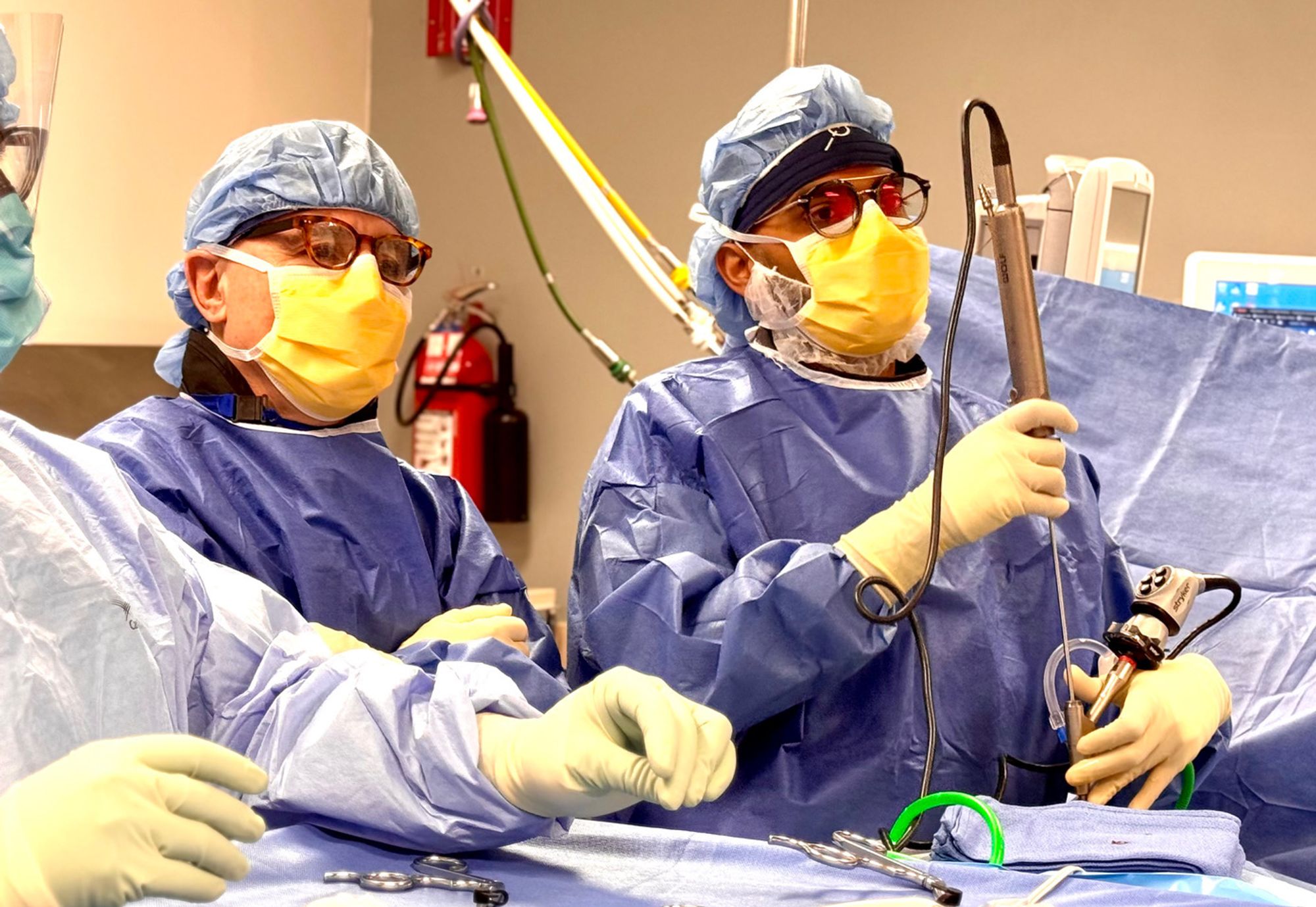
Endoscopic spine surgery is a minimally invasive approach built for conditions affecting the spine, which sets it apart from arthroscopy. For lumbar disc herniation, spinal stenosis, foraminal narrowing, and nerve compression, endoscopic tools and technique are specifically designed for the spinal column's anatomy.
When comparing endoscopic spine surgery vs arthroscopic spine surgery, the distinction is straightforward: arthroscopic surgery for joints was not designed for the spine. The instruments, the surgical angles, and the tissue-handling approach are all built for joint cavities. Using arthroscopic tools in a spinal context would be like trying to use a knee instrument set on a spinal disc: technically related, but practically a poor fit.
Published outcomes for endoscopic decompression are encouraging, though results vary by condition, which is why endoscopic surgery success rates are best read alongside your own imaging and history. Most people with disc and nerve problems begin with conservative care such as physical therapy, medication, and activity changes, and surgery is usually considered when symptoms persist or nerve function is affected.
ESINY applies this approach to advanced spinal cases. More than 40 spine surgeons have had surgery at ESINY themselves when they needed it, a meaningful signal of trust among the surgical community.
If you're exploring endoscopic spine surgery as an option, you can request a consultation with the ESINY team to review your imaging and discuss your history in a one-hour new-patient visit.
What Orthopedic Endoscopy and Joint Arthroscopy Each Do Best

The line between these two techniques isn't always a hard boundary, and that's an important nuance worth understanding clearly.
Orthopedic endoscopy refers to endoscopic techniques applied to non-joint musculoskeletal structures. Carpal tunnel release, plantar fascia release, and iliotibial band (ITB) release are all examples where endoscopic tools access soft tissue outside a joint cavity. This is distinct from arthroscopy, which operates inside joints.
Surgeons also combine endoscopic and arthroscopic techniques, such as endoscopic iliotibial band release performed during hip arthroscopy, which shows how the line between these two approaches continues to evolve.
So when someone asks about the differences between orthopedic endoscopy and joint endoscopy, the answer is: orthopedic endoscopy is the broader umbrella, encompassing both arthroscopic procedures (inside joints) and non-arthroscopic endoscopic procedures (outside joints). They can even occur in the same surgical case.
For elbow conditions specifically, arthroscopy can be a challenge, but its indications and benefits compared to open elbow surgery continue to evolve. In the right context, arthroscopic joint surgery is also a strong alternative to traditional open surgery.
The takeaway: arthroscopic surgery for joints vs endoscopic spine surgery aren't competing options. They serve different anatomical needs, and understanding that difference leads patients to the right specialist faster.
Talk to ESINY About Your Minimally Invasive Spine Surgery Options
If you've been researching the differences between these two procedures, chances are you're trying to make sense of a real diagnosis, and the distinction matters. Arthroscopy is the right tool for joints. Endoscopy, specifically the advanced spinal endoscopy practiced at the Endoscopic Spine Institute of New York (ESINY), is the right tool for the spine. They're not interchangeable, and knowing the difference can save you time, confusion, and a referral to the wrong specialist.
ESINY focuses entirely on endoscopic spine surgery. Every new patient receives a one-hour visit where the team listens before offering anything. Surgeons follow up personally the day after your procedure, and you have direct physician access throughout your care. This is concierge-level care built around your specific case, your imaging, and your goals.
If you're dealing with a spine condition and want to understand whether endoscopic surgery is right for you, request a consultation with ESINY, the Endoscopic Spine Institute of New York. Our team can review your imaging, walk through your options in plain language, and help you decide on next steps, no pressure, just clarity.