
Degenerative Disc Disease Surgery

Disc degeneration does not mean living with pain or committing to a major spine surgery, despite what you’ve probably been told. Treat your degenerative disc disease, spondylosis, and foraminal stenosis using the most advanced spine surgery available in the world.

Our award-winning New York team at ESINY uses an incision smaller than 1 cm and image-guided precision to reach crowded nerve spaces. No fusion. No rods or screws. No long recovery. Most patients return home the same day as surgery with minimal discomfort and a band-aid.
What is Degenerative Disc Disease?

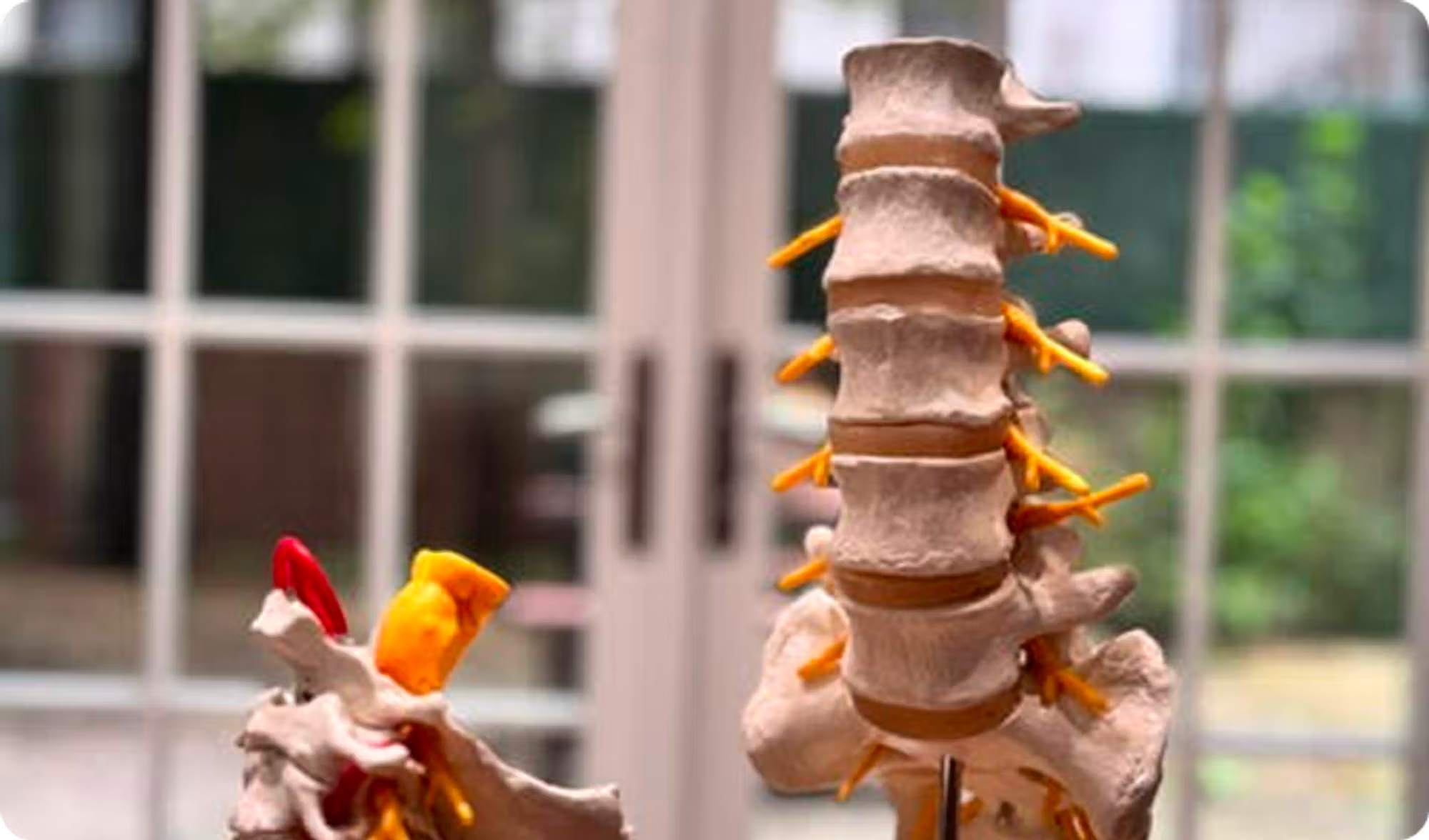
Degenerative disc disease describes natural changes that happen in the spine over time. As discs age, they can lose hydration and height, reducing the cushion between the bones of the spine. This leads to increased friction, joint stress, and irritation of nearby nerves.

As degeneration progresses, it often overlaps with spondylosis, which refers to arthritic changes in the spine, and foraminal stenosis, where the small openings that nerves pass through become narrowed. These tight spaces matter. Even a few millimeters of crowding can trigger persistent symptoms that affect your daily life.

Degeneration does not mean instability, and it does not automatically mean fusion. In many cases, the real problem is pressure on a nerve, not the disc itself.

Your Path to Relief with Endoscopic Treatment

Endoscopic spine treatment offers the most precise, minimally invasive solution for treating your degenerative disc disease.

Lowest Risk of Any Spine Surgery

For degenerative disc disease, our endoscopic approach often keeps risk to a minimum, with an infection rate of just 0.001% and ten times less blood loss than open spine surgery. Most patients return to work and daily life up to ten days faster, without the higher complication rates linked to traditional spine procedures in this delicate part of the spine.

Lowest Risk of Any Spine Surgery

Minimally Invasive to Support a Smoother Recovery

Traditional spinal surgery often treats degeneration with large incisions, muscle disruption, and fusion. Our endoscopic decompression approach focuses instead on restoring space where nerves are compressed. Using the smallest incision and a high-definition camera, we reach the problem disc without disrupting the surrounding structures, which can mean less pain, less scarring, and a faster recovery.

Minimally Invasive to Support a Smoother Recovery

95% Walk Out the Same Day—with Less Pain

Almost every patient goes home the same day and starts light activity right away. There’s no overnight stay and no drawn-out recovery.

95% Walk Out the Same Day—with Less Pain

Say Goodbye To General Anesthesia

Some patients with degenerative spine conditions can undergo treatment using light sedation and local anesthesia rather than full general anesthesia. You remain comfortable and relaxed while avoiding the recovery burden that often comes with deeper sedation. General anesthesia remains available when appropriate.

Say Goodbye To General Anesthesia

Precision Treatment For Your Symptoms

Our endoscopic treatment is designed to address:

  • Chronic back pain that worsens with activity
  • Pain that radiates into the arms or legs
  • Numbness or tingling caused by nerve pressure
  • Loss of endurance when walking or standing
  • Stiffness from spondylosis
  • Reduced range of motion
  • Discomfort linked to foraminal narrowing

Meet ESINY

Meet Your Team Transforming the World of Spine Surgery

ESINY leads the way in endoscopic spine treatment. Our award-winning doctors focus on treating the exact source of your symptoms with exceptional precision, potentially longer-lasting results, fewer side effects, and recoveries often faster than traditional surgery or injections.

With decades of combined experience, our internationally recognized team has presented at more than 500 conferences — including the North American Spine Society and the Society for Minimally Invasive Spine Surgery — and published over 300 papers in peer-reviewed medical journals. They’ve also earned honors such as Honorary Member of the American Academy of Neurological and Orthopedic Surgeons, giving you access to precision medicine supported by unmatched expertise.

What To Expect

Your consultation focuses on your symptoms, imaging, and prior treatments such as injections or physical therapy. If you are a candidate for endoscopic decompression, we explain the plan in detail so you know exactly what to expect.

Our approach is the most minimally invasive surgical option available in the world for treating disc degeneration. By using a very small incision (the size of a pencil eraser), we often achieve faster recovery, fewer side effects, and avoid the need for large muscle dissection. Many patients only need a local anesthetic, and 95% return home the same day.

In the week after your procedure, your ESINY doctor will personally call you to check your progress and answer any questions, making sure you have guidance every step of the way.

What To Expect
Candidate Icon

Are You a Candidate?

Many patients come to us after being told to wait, manage symptoms indefinitely, or prepare for fusion. Others have tried injections or therapy without lasting relief. If degeneration has narrowed nerve pathways but left your spine stable, you might be a candidate for precise endoscopic decompression. Each case receives individual evaluation, with the goal of relieving pressure while preserving long-term function.

Join the 30,000+ Patients Who Have Found Relief

CONTACT US

Endoscopic Spine Surgery

Frequently Asked Questions

Endoscopic surgery for degenerative disc disease is a form of minimally invasive spinal surgery that focuses on relieving nerve pressure caused by age-related changes in the spine. As intervertebral discs lose height and flexibility, surrounding structures can crowd the spinal canal or nerve exit zones. Using a small camera and specialized instruments, our spine surgeons treat the exact area causing symptoms through a very small incision, without fusion or large tissue disruption.

This procedure allows our award-winning spine specialists at ESINY to treat degenerative disc disease with greater precision and less trauma than traditional spinal surgery. Most patients go home the same day, experience less postoperative pain, and recover faster while protecting healthy structures of the spine.

Traditional spine surgery often involves larger incisions, muscle stripping, and fusion to address disc disease. At ESINY, our minimally invasive techniques focus on decompressing nerves while preserving spinal stability. By avoiding unnecessary bone removal and hardware, we reduce disruption and support a smoother recovery.

Injections can temporarily reduce inflammation, but they do not correct nerve compression caused by degenerative disc changes. Endoscopic surgery builds on the concept of precision by directly addressing the structural source of symptoms rather than masking pain. It offers a minimally invasive approach with the potential for longer-lasting relief.

Degenerative disc disease can cause a wide range of symptoms depending on where nerves are affected. These may include back and neck pain, leg pain, numbness, tingling, weakness, or stiffness. In some cases, symptoms overlap with spinal stenosis or spondylosis as spaces around nerves become more crowded.

Degenerative disc disease develops over time as part of the natural aging process. Contributing factors include loss of disc hydration, repetitive stress, posture, genetics, and prior injury. As discs shrink, nearby joints and bone can thicken, leading to nerve compression within the spinal canal or foraminal openings.

Yes. When performed by experienced spine surgeons with advanced surgical expertise, endoscopic decompression often carries a lower risk than open surgical treatments. It typically involves less bleeding, fewer complications, and faster recovery.

Many patients undergo treatment with local anesthesia and light sedation, though general anesthesia remains an option if preferred. This flexibility allows treatment to be tailored to your comfort and medical needs.

95% of patients walk out the same day and return to light activity quickly. Symptoms related to nerve compression often improve early. Recovery timelines are typically shorter than those associated with traditional spinal surgery.

Patients usually report mild postoperative discomfort rather than significant pain. Heavy pain medications are rarely required.

The incision is under 1 cm, about the size of a pencil eraser, and usually heals with minimal visible scarring.

Endoscopic spine surgery requires advanced training and experience. Few centers in the country perform these minimally invasive procedures at a high level for complex spine conditions such as degenerative disc disease and foraminal stenosis.

Yes. In many cases, results equal or exceed those of open spine surgery. By relieving pressure on the spinal cord and nerves while preserving anatomy, patients often return to activity sooner with less disruption to daily life.

You Deserve to Know Your Options

Your path to reclaiming your life starts here.

Find out why endoscopic spine surgery is right for you

Contact Us