


Endoscopic neck pain surgery relieves the pinched nerve in your neck through a single incision under 1 cm, with no fusion, no plate, and no screws. Most patients go home the same day.
When neck pain turns into arm pain or numbness, it’s often a nerve getting compressed in your cervical spine. That pattern has a name, cervical radiculopathy, and it is the most common reason neck pain becomes a surgical question. With endoscopic cervical procedures, we can decompress that nerve through a small portal: no muscle stripping, no long hospital stays, and a quicker return to normal life.
What Neck and Arm Pain Usually Means

These symptoms may show up as tingling in your fingers, a dull ache in your shoulder, or even weakness in your grip. They can interfere with simple things like writing, typing, or lifting. But they’re also treatable, and treatable early before they worsen.
Where you feel it tells us a lot. The C7 nerve root is involved in more than half of cases and C6 in roughly a quarter, which is why symptoms so often land in the forearm, hand and fingers rather than in the neck itself. Pain that stays in the neck and shoulders, without traveling down the arm, usually points somewhere different.
Most of the time the underlying cause is ordinary wear. Discs lose height, the joints stiffen, and the small openings the nerves travel through get tighter. Degenerative disc disease is the usual name for that process, and it shows up on the imaging of plenty of people who feel nothing at all. What matters is whether the narrowing is touching a nerve.
When Does Neck Pain Need Surgery?

Most of the time it does not. More than 85 % of acute cervical nerve pain settles without any specific treatment inside 8 to 12 weeks, and around 88 % of patients improve within four weeks of nonoperative care. Physical therapy, anti-inflammatories, activity changes and time are the right first step for almost everyone, and we will say so.
Neck pain on its own is a weaker reason to operate, and that is what most patients get told. Worth knowing, though: many of our patients tell us their neck pain eased after surgery too, not just the arm symptoms. It is not the reason we operate, but it happens often enough that it is worth saying out loud.
The conversation usually turns surgical when imaging matches your symptoms and four to eight weeks of genuine conservative care has not moved things. Some situations move faster.
Weakness that keeps getting worse, a grip that gives way when you are carrying something, or numbness spreading into both hands all deserve prompt review. Trouble with balance or walking, clumsy hands, or any change in bladder or bowel control points to pressure on the spinal cord rather than a single nerve root, and that needs same-day care.
How Endoscopic Neck Pain Surgery Works
The procedure is an endoscopic posterior cervical foraminotomy, one of the approaches within endoscopic spine surgery. It works from the back of the neck, through the opening the nerve already uses to exit the spine, so in most cases no bone has to be removed to reach it.
We review your high-resolution imaging to see exactly where the nerve is being compressed. Then, using the endoscope, we relieve that pressure with tiny instruments. The surrounding muscles are preserved. The recovery is shorter.
We take out only what is crowding the nerve and leave the rest of the disc and the joints alone. Because the working portal is under 1 cm, many of these procedures are done awake, under local anesthesia with light sedation. For patients whose age or heart and lung history makes general anesthesia a risk, that difference can decide whether surgery is available at all. General anesthesia is still there when it is the better choice.
How This Compares to ACDF and Neck Disc Replacement
If you have been reading about neck surgery, you have met two other names: ACDF, short for anterior cervical discectomy and fusion, and cervical disc replacement. Both are good operations. Both go in through the front of the neck, and both begin by removing the whole disc. This one does neither.
Endoscopic foraminotomy | ACDF (fusion) | Cervical disc replacement | |
|---|---|---|---|
Approach | Back of the neck | Front of the neck | Front of the neck |
Incision | Under 1 cm | 1 to 4 inches | 1 to 4 inches |
Anesthesia | Often local with light sedation | General | General |
Disc removed | Only the fragment pressing on the nerve | Entire disc | Entire disc |
Hardware left in | None | Plate, screws and a graft or cage | Artificial disc implant |
Motion at that level | Preserved | Fused | Preserved by the implant |
Hospital stay | Same day | Commonly one night | Commonly one night |
Full recovery | Light activity within days | Fusion takes 6 to 12 months | About 3 to 4 months |
The direction of the approach matters more in the neck than people expect. Going in from the front means passing beside the windpipe and the food pipe, which is why some patients notice a sore throat, a hoarse voice or difficulty swallowing for a while afterward. Going in from the back avoids that route entirely. It is not a reason to rule out a fusion when a fusion is what you need, but it is a real difference worth asking your surgeon about.
An Endoscopic Alternative to Neck Fusion

Fusion has its place. When the neck is genuinely unstable, cervical fusion is the right operation and we will tell you so. Where the problem is a nerve with no room, and the spine is otherwise stable, an endoscopic decompression can often solve it while leaving the disc and the movement at that level intact. Your spine is meant to move, and we would rather keep it that way where the anatomy allows.
A lot of the people we see at our NYC practice arrive having already been told a fusion is the next step, and for some of them it genuinely is. For others, the imaging tells a different story, and that is worth finding out before anything is scheduled.
Revision After a Failed Neck Surgery
If you have already had neck surgery and the arm pain came back, you are not an unusual case. Pain that returns months or years after a fusion is common enough to have its own name. Sometimes the original level never fully decompressed. More often the level next to the fusion takes on the load the fused segment no longer shares, and that level narrows in turn.
The instinct is to extend the fusion. It is not always necessary. Because an endoscopic approach works through the back of the neck, it can usually reach the nerve without disturbing the hardware already in place or adding more. Revision after a failed spine surgery is one of the more common reasons patients travel to us, and scar tissue from a previous operation does not rule it out.
What it comes down to is your imaging. A scan shows whether the compression is at the old level or a new one, whether the neck is stable, and whether the hardware is doing its job. Send it through our contact form, and we will tell you where you stand, including when the honest answer is that a revision will not help you.
What Patients Tell Us Afterward
We surveyed our own patients and published what they said. In a series of 183 patients reported in the International Journal of Spine Surgery, 89.2 % described better outcomes than they had had with traditional spine surgery, 98 % said they would recommend the procedure, and 78.7 % of those working beforehand went back to work. The average patient was 68 years old, and the oldest was 89.
Arm symptoms tend to ease first, sometimes before you leave the building. Numbness and strength take longer, because a nerve that has been compressed for months needs time to recover even once the pressure is gone. Neck stiffness that built up over years does not vanish either, and we would rather tell you that up front than have you surprised by it. Your surgeon gives you a timeline built around your case, your level and the work you actually do.
Why Patients Choose ESINY for Neck Pain Surgery
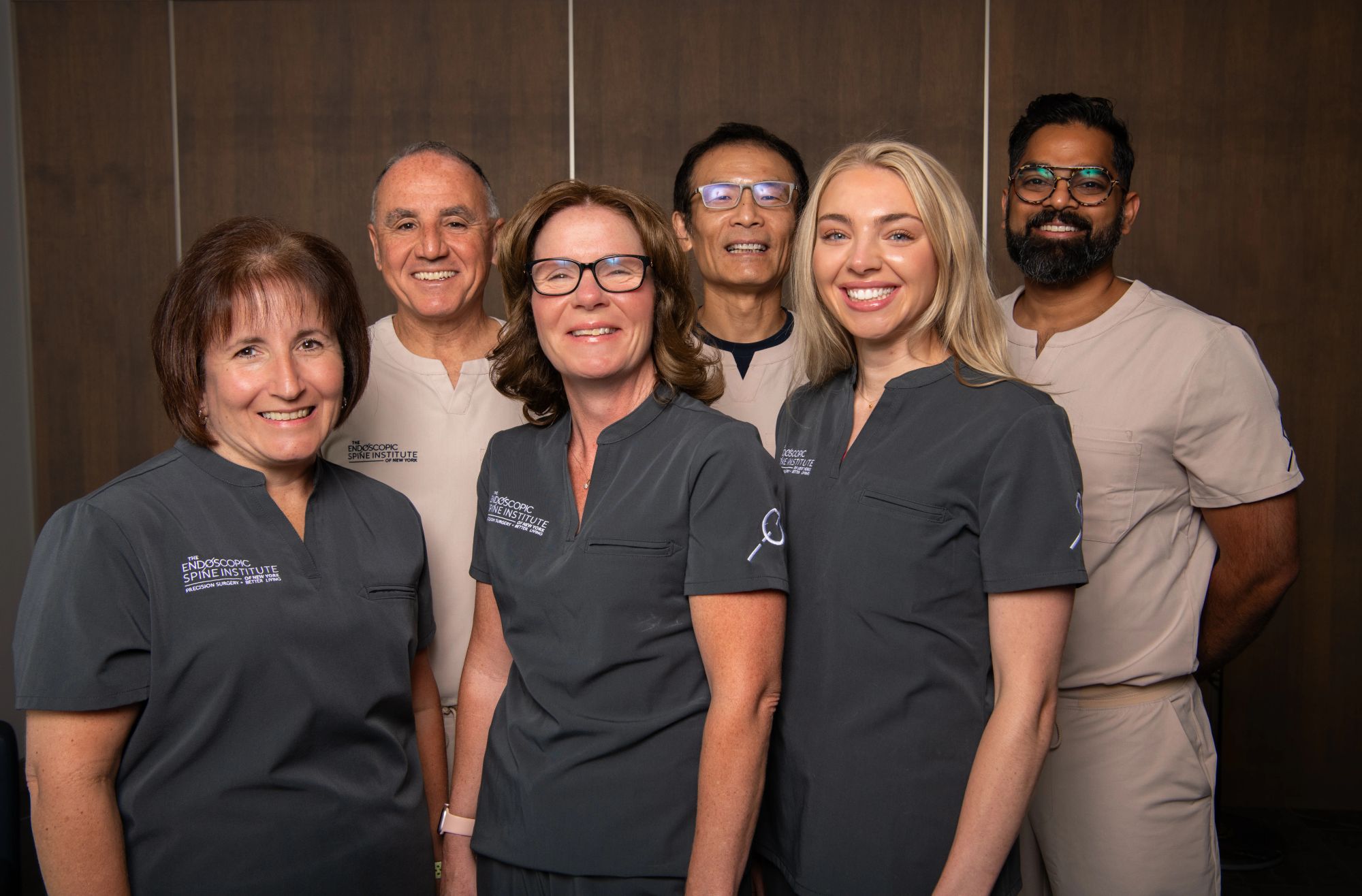
ESINY focuses entirely on endoscopic spine surgery, which is unusual in this field. That focus is what builds the volume, and volume is what makes outcomes at this level of the neck predictable. Our surgeons have published over 300 peer-reviewed papers and presented at more than 500 conferences, and roughly 50 spine surgeons have come to ESINY for their own spine surgery.
The care around the procedure matters too. New patient visits run a full hour at our New York City office. Your surgeon calls you personally the day after your procedure, and you have direct email access to your physician through recovery.
Neck and arm pain are signals. We’re here to interpret them, treat the cause, and get you back to feeling strong, mobile, and in control of your health again. Send your imaging through our contact form, and we will tell you where you stand.