


Yes. Endoscopic spine surgery is very safe in experienced hands, and it generally carries lower risk than traditional open spine surgery, with less bleeding and fewer complications. That said, no operation is risk-free, and anyone asking whether endoscopic spine surgery is safe deserves the full picture rather than reassurance. This guide covers the real risks, the safety data behind the endoscopic approach, who the procedure is not right for, and the single factor that changes your risk more than any other.
Key Takeaways
- Endoscopic spine surgery carries lower risk than open surgery: less blood loss, fewer complications, and a smaller wound.
- At ESINY the infection rate is 0.001% and blood loss is ten times lower than traditional open surgery.
- Real risks still exist, including bleeding, infection, nerve irritation, dural tear, and incomplete relief of symptoms.
- Many procedures avoid general anesthesia entirely, which removes a meaningful category of surgical risk.
- Surgeon experience and case volume affect endoscopic spine surgery risk more than the technology does.
Is Endoscopic Spine Surgery Safe? What the Numbers Show
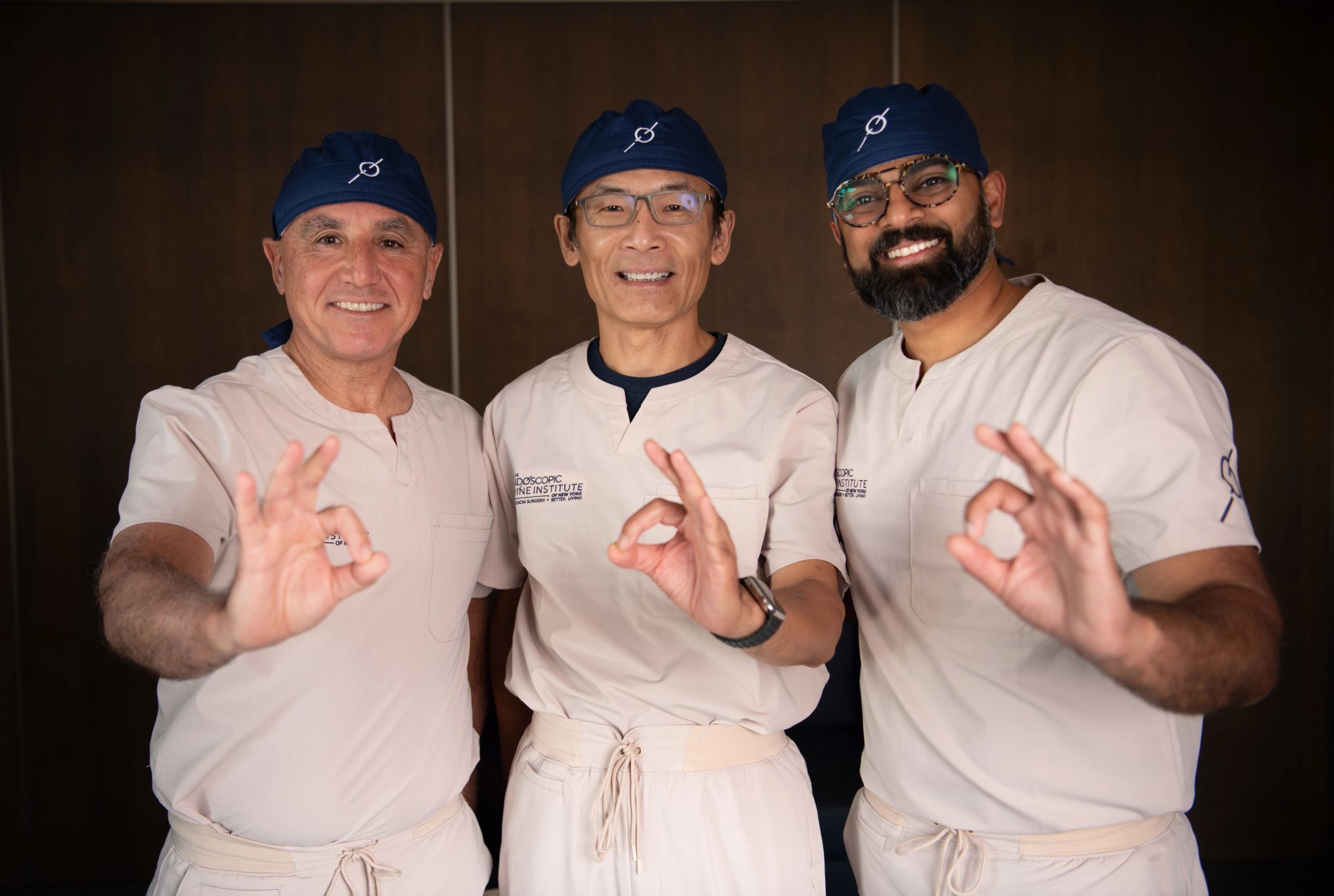
Safety in spine surgery comes down to how much of your body the operation has to disturb to fix the problem. Endoscopic spine surgery is the smallest spine surgery that exists. A camera the size of a pencil eraser reaches the spine through an incision under 1 cm, passing between muscle rather than cutting through it, and no hardware is left behind.
Here is how that compares on the measures that drive surgical risk.
Safety measure
Endoscopic spine surgery at ESINY
Traditional open spine surgery
Incision
Less than 1 cm, about a pencil eraser
Large incision
Muscle and bone
Not cut. Instruments pass between structures.
Muscle cut and pulled back, bone often removed
Hardware
None
Often rods and screws
Anesthesia
Often local anesthesia with light sedation
Typically general anesthesia
Blood loss
Ten times less
Higher
Infection rate
0.001%
Higher than endoscopic
Hospital stay
95% go home the same day
Recovery measured in months
One point deserves emphasis. Many ESINY procedures are performed under local anesthesia with light sedation rather than general anesthesia. For older patients and anyone with heart or lung conditions, avoiding general anesthesia removes an entire category of risk from the equation. You can read more about how the endoscopic technique works and what it involves.
What Are the Risks of Endoscopic Spine Surgery?
Any procedure that involves an incision carries risk. Endoscopic spine surgery reduces these risks compared with open surgery, but it does not eliminate them. An honest list looks like this:
- Bleeding. Minor bleeding is possible, though blood loss is substantially lower than in open procedures. No major blood vessels ever encountered. Blood loss significantly less and very minimal
- Infection. Very rare, but inherently, every incision carries some infection risk. The smaller the wound, the lower that risk tends to be.
- Nerve irritation or injury. The work happens near spinal nerves, so temporary numbness, tingling, or weakness can occur. Lasting nerve injury is uncommon.
- Dural tear. The membrane around the spinal cord can be nicked, which may require additional treatment. But this is very rare.
- Incomplete relief. Symptoms may not fully resolve, or they may return over time.
- Need for further surgery. In some cases, a second procedure is required.
None of that is unique to endoscopic spine surgery. It is the standard risk profile of spine surgery, and in trained, high-volume hands these techniques carry lower complication rates than open surgery. A meta-analysis of 26 studies covering 2,577 patients published in the Journal of Neurosurgery: Spine found shorter hospital stays and better postoperative outcome scores with endoscopic discectomy than with open microdiscectomy.
Why Endoscopic Spine Surgery Is Safer Than Open Spine Surgery
Traditional spine surgery creates damage on the way to the problem. Muscle is cut and retracted, bone is often removed, and rods and screws may be placed. Your body then has to repair all of that on top of the original condition. Hardware carries its own long-term problems too, because the body does not respond well to foreign objects and they can generate new symptoms years later. This is a large part of why patients seek out endoscopic treatment for a herniated disc rather than a fusion.
Endoscopic spine surgery avoids most of that. Less tissue disruption means less bleeding, less infection exposure, and no hardware. Those are not marketing benefits. They are the specific mechanisms that make the procedure safer.
Outcomes follow the same pattern. Our breakdown of endoscopic surgery success rates covers what the results data actually shows across conditions.
Safety Depends on the Surgeon, Not Just the Technique
This is the part most articles leave out, and it matters more than anything else on this page.
Endoscopic spine surgery has a steep learning curve. It demands specialized training and equipment, and case volume is what turns training into competence. A surgeon who performs these procedures occasionally does not carry the same complication rate as one who performs them constantly. When patients ask whether endoscopic spine surgery is safe, the honest answer is that it is very safe in experienced hands, and the word doing the work in that sentence is experienced.
This is worth asking about directly. ESINY is the nation's first and only endoscopic spine institute, focused solely on this procedure rather than offering it as one option among many. Our surgeons have collectively treated more than 30,000 patients with this approach, published more than 300 peer-reviewed papers, and presented at over 500 conferences worldwide. More than 40 spine surgeons have chosen this procedure, and this team, for their own spine care.
Who Endoscopic Spine Surgery Is Not Right For
A safety conversation is incomplete without this. Endoscopic spine surgery is not the answer for everyone, and being told so is a good sign about the surgeon you are talking to.
Most patients should exhaust conservative care first. Physical therapy, injections, activity changes, and time resolve a great many spine problems without an operation. Surgery generally enters the conversation only when symptoms persist despite genuine attempts at conservative treatment, or when nerve compression is progressing.
Beyond that, suitability depends on your imaging, your anatomy, where the problem sits, and your overall health. Some conditions are better served by a different approach, and a surgeon who tells you that is protecting you. Who is a candidate for endoscopic spine surgery walks through the criteria in detail.
Questions to Ask Your Surgeon About Endoscopic Spine Surgery Safety
If you take one thing from this page, take this list into your consultation:
- How many endoscopic procedures have you personally performed?
- What percentage of your practice is endoscopic, and what do you do the rest of the time?
- What is your complication rate, and what are the most common complications you see?
- Will I need general anesthesia, or can this be done with local and sedation?
- What happens if the endoscopic approach does not fully resolve my symptoms?
- Am I a candidate for a smaller procedure than the one I have been offered elsewhere?
FAQs About Endoscopic Spine Surgery Safety
Is endoscopic spine surgery safe for older patients?
Often yes, and sometimes it is the safer option specifically because of age. Procedures performed under local anesthesia with light sedation avoid the risks that general anesthesia can carry for older patients or those with heart and lung conditions.
What is the infection rate?
At ESINY the infection rate is 0.001%. The sub-centimeter incision is sealed with medical glue and covered with a custom ESINY bandage.
Is it as effective as open surgery, or am I trading results for safety?
You are not trading one for the other. Published comparisons show endoscopic discectomy achieving outcomes comparable to or better than open microdiscectomy, with shorter stays and faster return to work.
Can endoscopic spine surgery be done if I already had spine surgery?
In many cases yes. Revision procedures can sometimes be performed endoscopically around existing hardware, avoiding a second large operation.
How painful is it afterward?
Most patients report very little pain and manage with mild over-the-counter pain relievers rather than stronger medication.
What should worry me after surgery?
Call your surgeon the same day for new weakness, loss of bladder or bowel control, fever, or drainage from the incision. At ESINY you have direct email access to your physician, so raising a concern is never difficult.
So, Is Endoscopic Spine Surgery Safe?
In conclusion, yes. It is safer than the open alternative on nearly every measure that matters: smaller wound, no hardware, often no general anesthesia at all. Published infection rates for endoscopic procedures run as low as 0.001%, against roughly 3% for spine surgery overall. What remains is real but low, and it drops further with an experienced, high-volume team.
Fear of spine surgery keeps a lot of people in pain for years longer than necessary. If that describes you, contact our team and tell us your story. We will give you a straight answer about your options, including whether surgery is the right step at all.
This post was written and reviewed by Sanjay Konakondla, MD. Sanjay Konakondla is a leading endoscopic spine surgeon and a founding partner of the Endoscopic Spine Institute of New York.
ESINY is the nation’s first and only endoscopic spine institute and is solely focused on the smallest spine surgery possible. With the world-renowned neurosurgeons at ESINY and the specialized surgery they have perfected, you can feel confident that you will have the best chance at getting back to the life you deserve with the least amount of surgery.
Call us now at 518 708 6300 or email us directly at contact@esiny.com to schedule a consultation.